You'd have to ask the manufacturer what to do on the baffles, cutting off and re-welding baffles might be harder as they can't cut the baffles off flush to the wall of the vessel without some risk of cutting the sidewall very easily, seems like plasma cutting would be easier/safer for them to attempt. I'm not sure this will fix your mixing issue completely though, so it might be best to save that as a last resort after you get the mixer blades fixed or improved on. Then if you are seeing good churning with better blades, then you might even decide to take the leap and cut out all or part of the baffles.
On our mash mixer our blades are about 10 inches off the bottom of the vessel out at the tips of the blades, but we have a coned bottom mash mixer so in the middle the blades are quite a bit higher off the bottom. We didn't get good mixing in this cone area under the blades, so we did a cheap fix and just welded a vertical piece of 4 inch stainless flat bar down from the mixer shaft and it sits about an inch off the bottom of the tank. It helps stir the mash around under the center of the blades but had an added benefit of keeping the mash moving right until the very last bit of mash leaves the vessel.
Original Message:
Sent: 04-02-2024 14:12
From: Michal Frankowicz
Subject: Mash Mixer Designs
Hey Curtis,
Thank you for the great info. We have tried the second set of blades about a foot below the liquid level and it definitely helped, but we still could not get movement off of the walls unless we increased speed, and that caused a lot of turbulence. I have not tried the second set with upward flow, but will try tomorrow.
I agree with the slots on the baffles, but also understand how big of a headache that might be for the manufacturer. Would it it make sense to just cut them completely off and add new ones instead of trying to cut out channels and buffing out the excess material?
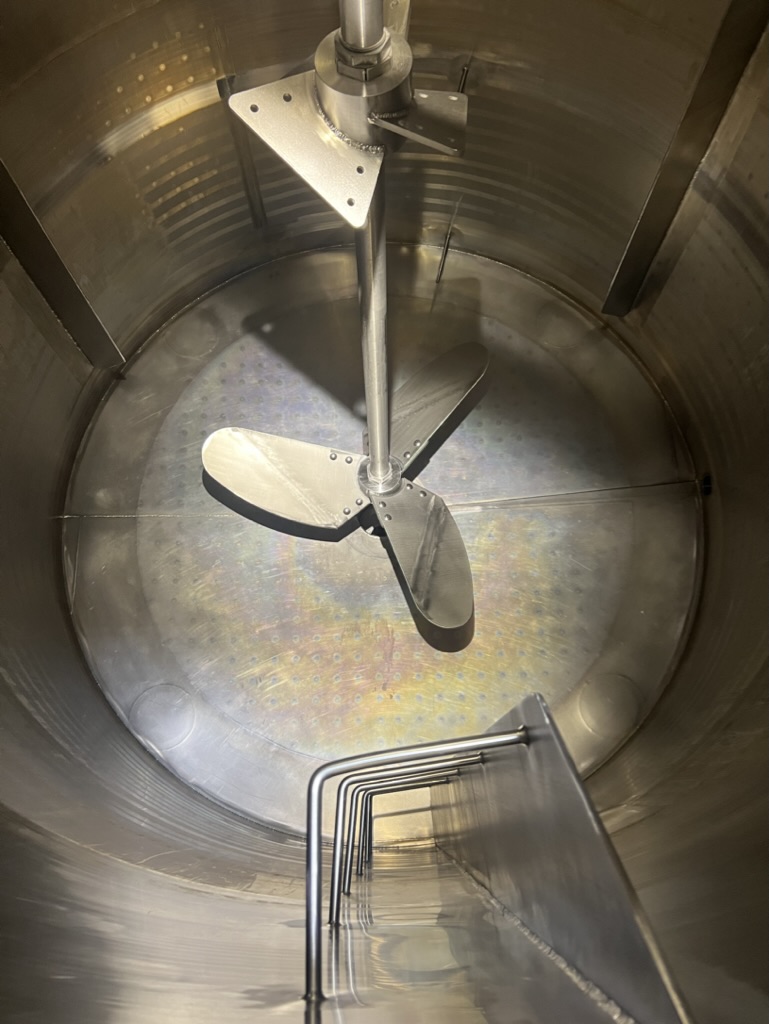
The picture is a bit deceiving. The blades are about 18" off of the bottom currently and that is as low as we can get them with this design. I would like to see them a lot lower since the last 10bbls of mash has no agitation when mashing out and causes a lot of grain to stick behind unless we use a lot of water to rinse out. All of the mixers I have seen are usually 4-6" off the bottom. Is that the case for yours?
------------------------------
Michal Frankowicz
Head Brewer
Fort George Brewery
Astoria, OR
503-298-3174
------------------------------
Original Message:
Sent: 04-01-2024 22:04
From: Curtis Holmes
Subject: Mash Mixer Designs
Hi Michal,
Thanks for the picture. Your mash mixer blade size and the baffles looks just like my first mash tun experiences with a new manufacturer, and it worked about as horribly as yours does. I agree with others that your blades look too small. We didn't see the shear you are seeing, but had the same poor mixing results. I would definitely recommend longer mixer blades or a mixing blade redesign if the manufacturer is working with you to resolve this. If the manufacturer isn't too excited about a blade redesign you could keep the lower mixer that you have, and have the manufacturer give you another set of blades and mount them higher up on the shaft, about 1-2 feet below the liquid level. In your picture it looks like the manufacturer already left you another set of mixer blade mounting plates higher up on the shaft so it would be easy to add and test. It's not a great fix to have doubled up mixer blades but it will help, we did this with our first mash tun design and we were able to make it work for several years until we could retrofit the entire mash tun.
I also noticed that your baffles are solid welded down the entire length of the vessel, so all of your grain is just slamming into all of these baffles. The manufacturer is expecting all the grain to move up to the top but the force against the baffles can create a lot of shear in addition to giving you a lot of dead corners that might create poor mixing zones where the grain can't get hydrated. On our mash tun the manufacturer had designed in several 2 inch wide gaps down the length of the baffles so mash could at least move through and around the baffles. See the attached sketch of what our first mash tun looked like after we added the second mixer blades. This isn't an easy fix to add the slots to the baffles now and may not fix all of your problems, but they could plasma cut some holes in the baffles just to help movement and mixing in those areas, and this would also help break up any clumps of grain that aren't hydrated fully yet.
One final idea is to try to move your mixer blades up off the bottom of the vessel, they look really close to the bottom and that could be restricting good movement around the blades.
------------------------------
Curtis Holmes
Alaskan Brewing Co
Original Message:
Sent: 04-01-2024 18:16
From: Michal Frankowicz
Subject: Mash Mixer Designs
Below is a photo of the mixer. We just tried a mash in with upward flow and after about 75% of the mash in, we stopped getting any rotation and the grain sat on top. I do believe this is the right direction, but the blades are too short for this, or the baffles stick out too far.
We did run a mash earlier today with slowing down to 30% during rests, and it was definitely better, but still had a nice cake in the lauter that caused some severe channeling. We notice that if we turn off the mixer in the mash, everything seems to float up, as far as we can tell of course. All of this would be so much easier if we just had a glass mash mixer to see what was going on.
------------------------------
Michal Frankowicz
Head Brewer
Fort George Brewery
Astoria, OR
503-298-3174
Original Message:
Sent: 04-01-2024 15:00
From: Curtis Holmes
Subject: Mash Mixer Designs
Hi Michal,
Do you have a picture you can post of your current mash tun setup?
You can try to run the mash mixer at a higher speed when heating up the mash for good heat dispersion. Keep the mixer running for 1-2 minutes after you get to your step temperature to allow the steam jackets to cool down but then turn off the mash mixer completely for the rest. Especially with the added baffles in your mash tun, this will get rid of a lot of extra shear you might be seeing, we eventually removed all the baffles in our old mash tun because of this shearing but we also changed our mixer design at the same time, it really depends on your mixer blades. Our newer blades are a twisted style so it spins the mash off the blades and helps mix with less shear, see attached pictures of some different blade versions.
If you don't feel comfortable completely turning off the mash mixer during the rest, then go to a really slow speed during your mash rests just to keep the mash from settling. Or a do a hybrid step where you just bump the motor for a few minutes every 5 minutes during your rests. You may find at lower temperatures that the mash settles too fast to the bottom so the mixer may need to stay running all the time at lower temperatures, but as the starches convert and the mash thins then you can get away with longer non-mixing times so it may take some experimentation on what works best.
As Karl mentioned, I would also check the rotation of your mixer blades. Even though it's not great to be pushing the mash down into the tank bottom, on one of our old mixer blade designs the incorrect rotation worked better than the correct rotation due to a poor blade design.
------------------------------
Curtis Holmes
Alaskan Brewing Co