Ask The Brewmasters

 View Only
  • 1.  Interesting Precipitate, Tetra?

    Posted 09-05-2023 18:47
    Brewers were getting ready to CIP a tank that was just filtered and discovered this interesting mystery meringue stuck on the sides.

    It's super white, very light and fluffy, dry and slightly crunchy, almost like a really fragile meringue. Beer was a Helles Festbier, been in there approximately seven weeks. Only real change was a test of adding some Tetra at 10ml/bbl along with enzymes, Firmcap and so on at Tank Full. I know the recommended method with Tetra is a nitrogen shot dose into the brite and that this is not the normal usage. But that is also kindof a PITA, and so we were curious what would happen. My first suspicion is that some or all of the Tetra precipitated thanks to the CO2. Or maybe it's something else, of course. Anybody ever have something like this happen to them? 

    If it is the Tetra reacting, second question becomes: Ok, why doesn't it do this in the brite tank too?
    Mystery Meringue


    ------------------------------
    Russell Everett
    Head Brewer
    Bainbridge Brewing
    Bainbridge Island WA
    (206) 451-4646
    ------------------------------


  • 2.  RE: Interesting Precipitate, Tetra?

    Posted 09-06-2023 14:54

    On further discussion, this tank appears to be one in which they tried adding Tetra at terminal along with the finings (Biofine Clear @ 100ml/bbl). So it would have gone into a co2 atmosphere. Hmmm...


    ------------------------------
    Russell Everett
    Head Brewer
    Bainbridge Brewing
    Bainbridge Island WA
    (206) 451-4646
    ------------------------------


  • 3.  RE: Interesting Precipitate, Tetra?

    Posted 09-06-2023 15:17

    I think it's fair to assume this is almost certainly a result of adding tetrahydroiso-alpha acids at tank full (that is, pre-fermentation). Tetrahydro-IAAs are well known to give a very dense and stable foam when used as post-fermentation bittering, so it's not a stretch to think it would do the same during fermentation. You seem to be targeting about 10 bitter units, based on this data sheet, which also notes that even at "3-5 ppm, foam stand and lacing are significantly enhanced".

    One of the reasons it's reccommended to use this post-maturation/clarification is that the molecule itself is much more surface-active than non-reduced IAAs (hence the higher foam activity). Basically, added at fermenter-full, the tetrahydro-IAAs will preferentially associate with evolving carbon dioxide bubbles (as well as fermenter walls, yeast cell walls, cold break and any other available surfaces) during primary. It's not necessarily precipitation, per-se (as in, it's not reacting chemically with something in the beer and coming out of solution), and so it doesn't really happen in the brite tank (unless you're getting lots of foam formation, such as with over-eager carbonation through a stone).

    Also, the fact that it's a lager fermentation probably allowed the formation of what's essentially finished-beer foam, as there wouldn't have been nearly as much "floating" yeast at the beer/headspace interface to interfere (I feel like you can kind of see that in your fermentation yeast ring).

    All in all, I think it's a pretty fair bet that what you're seeing is just dried-out, leftover, tetrahydro-IAA-enhanced foam from primary fermentation.


    ------------------------------
    Zandy Zeiser
    Brewer-at-large
    ------------------------------


  • 4.  RE: Interesting Precipitate, Tetra?

    Posted 09-06-2023 15:17

    Hi Russell,


    It seems plausible that the Tetra is responsible. If Tetra is added prior to fermentation (and at a pretty high dosage level too) Its foam positive effects can result in a much greater foam head being developed during fermentation. The reason it does not appear in the bright tank is because unless you are being careless with transfer counterpressures, low agitation, and carbonation techniques, there should not be much foam breaking out of solution in the bright. Basically, it is doing what you want it to do, but not when you want to do it!


    Kind Regards,

    Steve      

    Steve Bradt
    Craft Sales Representative
    Lawrence, KS 66044 USA
    Call or text: (785) 307-4587

    sbradt@hopsteiner.com
    www.hopsteiner.com

    "Hopsteiner Quality....The Proof is in the Pour"


    The information in this e-mail, and in any attachments, may contain confidential information and is intended solely for the attention and use of the named addressee(s). It must not be disclosed to any person without authorization. If you are not the intended recipient, or a person responsible for delivering it to the intended recipient, you are not authorized to, and must not, disclose, copy, distribute, or retain this message or any part of it.
      Please consider the environment before printing this e-mail notice.


  • 5.  RE: Interesting Precipitate, Tetra?

    Posted 09-06-2023 18:52
    Edited by Emma Nygren 09-12-2023 15:38

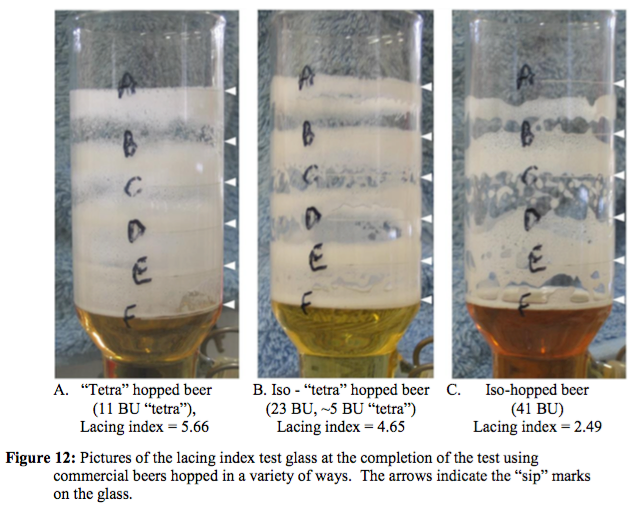
    Ah, tetra and foam.  That takes me back.  Some rather interesting observations you can make on this.  As beer lacing is controlled largely by hops, consider the following figure from Evans and Bamforth 2009.  Think your tank, only smaller...  

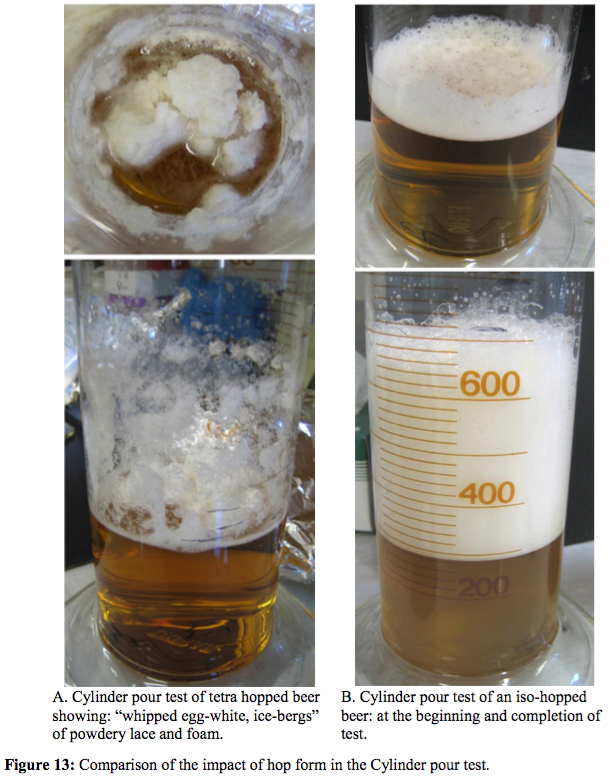
    Then consider the effect of over foaming with tetra.  On collapse you get these "foam-bergs." 
    References:

    Evans, D. E., And Bamforth, C.W. 2009. Beer foam: Achieving a suitable head. In: BAMFORTH, C. W., RUSSELL, I., AND STEWART, G.G. (ed.) Handbook of alcoholic beverages: Beer, a quality perspective. Burlington MA: Elsevier. pp 1-60.

    Evans, D. E., Surrel, A., Sheehy, M., Stewart, D., and Robinson, L.H. 2008. Comparison of foam quality and the influence of hop a-acids and proteins by five foam analysis methods. Journal of the American Society of Brewing Chemists, 65, 1-10, 10.1094/ASBCJ-2007-1129-01

    Evans, D. E., Oberdieck, M., Redd, K.S., and Newman R. 2012. The comparison of the foam stability analysis methods Rudin and NIBEM with a manual pour method to identify beer characteristics that deliver consumers stable beer foam. Journal of the American Society of Brewing Chemists, 70, 70-78, 10.1094/ASBCJ-2011-1205-01


    ------------------------------
    D. Evan Evans
    The Tassie Beer Dr
    Lindisfarne TAS
    61 362439556
    ------------------------------


  • 6.  RE: Interesting Precipitate, Tetra?

    Posted 09-07-2023 17:05

    Hi Russell 

    CO2 and Tetra do not get along so well!!. Did you get the target IBU?

    Tetra solubility is highly influenced by CO2. Some of the Tetra you added precipitated due to the producition or addition  of CO2.


    ------------------------------
    Edgar Finol
    Mechanical Engineer
    Ceveceria Polar CA
    Edo Carabobo
    +582418162250
    ------------------------------


  • 7.  RE: Interesting Precipitate, Tetra?

    Posted 09-08-2023 09:34

    The reason you don't use CO2 is that it will slowly react with the potassium salt of Tetra and convert the water soluble Tetra-K potassium salt into Tetra-H the insoluble acid. That being said, if your Tetra solution's exposure to CO2 was short, just long enough to push it into the beer you probably didn't experience this insoluble acid conversion. If the exposure was long, like an hour you definitely lost some of the Tetra to acid.  That all being said, did the receiving tank have enough pressure to insure there was no foaming from the beer being transferred into it? If there was not enough pressure in that receiving tank you could get excess foaming and Tetra would only exasperate that.  If you happen to have a sample of that meringue as you call it, send it to your hop supplier and ask them to test it to see if it contains isoalpha acids and Tetra. They would be able to tell you if it's hop acids or not.


    Cheers,


    John Paul Maye


  • 8.  RE: Interesting Precipitate, Tetra?

    Posted 09-11-2023 17:41

    Thanks for the help everyone! I think Dr. Evans' photos clearly illustrate the what happened. The Tetra made foam...just before we wanted it to. Presumably it got kicked up when we hit the tank with CO2 to mix up the Biofine. Interestingly, we had some fermcap in there...wonder how those two play together. Ah well, the beer tastes lovely and we have learned yet another What Not To Do. 


    ------------------------------
    Russell Everett
    Head Brewer
    Bainbridge Brewing
    Bainbridge Island WA
    (206) 451-4646
    ------------------------------