Ask The Brewmasters

 View Only
Expand all | Collapse all
  • 1.  HLT pH rise

    Posted 08-07-2023 17:08

    I have an issue with my hot liquor tank that has me stumped. Some background on our system: 10 BBL brewery. Steam-heated brewhouse and HLT. Brewing water is stored in Hot and Cold liquor tanks and is Reverse Osmosis with some softened water blended back in to increase the TDS. Source water is from our well, softened and chlorinated for the taproom, bathrooms, etc. The water is de-chlorinated via a carbon filter, then run through our RO system. The small amount of water blended back into the RO stream is from just after the carbon filter. I've had the brewing water tested and it's around 7.1 pH and very neutral (except for the 37ppm of Sodium from the blended water). 

    Here's my issue: Water goes into the HLT at around 7 pH. After time in the HLT at temp (186F), the pH starts to rise. The longer it's in the tank and kept hot the higher the pH rise. I've seen it get up to 8.5. My CLT is recycled into the HLT after the HeatEx. If I brew I usually only do one batch/week and many times I leave the HLT on to keep water hot for cleaning etc. That water doesn't get replenished until I need to brew again, and I top up the tank with fresh RO water. The larger pH rise comes after water has been in the HLT and kept hot for extended periods.

    Is that much of a pH rise normal? I understand that the pH might change with evaporation but going from 7 to 8+ seems wrong to me. Boiler water carryover has crossed my mind but I don't see any bubbles inside my tank from a leak and as far as I can tell I'm not losing boiler water. I'm wondering if anyone has seen this before and what steps I should take to remedy the situation. Thanks in advance.


    ------------------------------
    Tyrell Elliott
    Head Brewer
    Ghost Note Brewing
    Dripping Springs TX
    (406) 599-2071
    ------------------------------


  • 2.  RE: HLT pH rise
    Best Answer

    Posted 08-08-2023 13:07

    Hi Tyrell,

    The water pH generally doesn't matter.

    The water pH generally doesn't matter for corrosion potential unless it's less than 5.

    The water pH generally doesn't matter for determining mash pH.

    The corrosion potential of the water generally depends on its ionic constituents (or lack thereof). You say that the source water is softened and the RO filtered and then you add some softened water back to get the TDS up, leaving 37 ppm Sodium (inconsequential). In other words, you are brewing with low mineral water – all mineral levels less than 50 ppm. This means that the malts in the mash will generally dominate the chemistry of the mash, and the mash pH will be about 5.8 (i.e., dominated by the base malt).

    While I really would like to know the source water profile before softening, I would say that your pH rise is simply due to CO2 coming out of solution as the water temperature rises. Email me at john@howtobrew.com if you have any followup questions.

    John


    ------------------------------
    John Palmer
    Owner
    Palmer Brewing Solutions Inc
    La Crescenta CA
    ------------------------------


  • 3.  RE: HLT pH rise

    Posted 08-09-2023 21:37
    Edited by Walter Heeb 08-10-2023 16:35

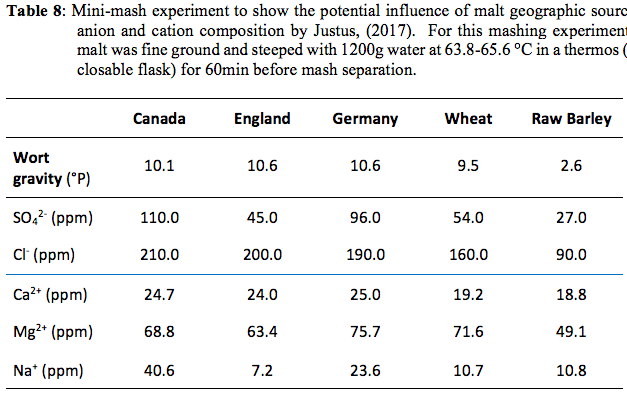
    I concur with what both John Palmer and Daniel Carey have said.  I would also underline what John pointed to with regards to the malt.  Malt with its proteins and ions at a typical mash ratio of say 1 part malt grist to 3 parts brewing liquor has a substantial ability to buffer and contribute to the wort characteristics.  To illustrate, this is a modest but very well targeted trial conducted by Aaron Justice (Brewmaster, Ballast Point Brewing).  This and other observations concur that there is significant variability in cation/anion proportions in malts from different geographical sources (Terroir?).  This understanding needs to be leavened by an excellent recent paper that considers the efficiency that those cations/anions are extracted into the wort and remain through kettle boiling, fermentation (Zn of course has its effect here - yeast nutrition) and finally the saleable beer.
    See: Wietstock PC, Kunz T, Waterkamp H, Methner FJ. 2015. Uptake and release of Ca, Cu, Fe, Mg, and Zn during beer production. J Am Soc Brew Chem 73:179-184. https://doi.org/10.1094/ASBCJ-2015-0402-01<o:p></o:p>  If you have further questions I can be contacted at tassiebeerdr@gmail.com.


    ------------------------------
    D. Evan Evans
    Dr
    The Tassie Beer Dr
    Lindisfarne TAS
    61 362439556
    ------------------------------


  • 4.  RE: HLT pH rise

    Posted 08-08-2023 13:08
    If the water tastes OK and your beer tastes OK and your mash pH is OK, you don't really have a problem to solve. pH of non-buffered water is extremely sensitive to small variations in dissolved material, including air gases.

    Roger Barth, PhD
    Professor Emeritus of Chemistry
    West Chester University
    rbarth@wcupa.edu

    Author of
    The Chemistry of Beer, The Science in the Suds, Second Edition. ISBN 978-1-119-78333-0
    Mastering Brewing Science: Quality and Production. ISBN 978-1-119-45605-6.

    ________________________________

    This e-mail message was sent from a retired or emeritus status employee of West Chester University.


  • 5.  RE: HLT pH rise

    Posted 08-08-2023 13:37

    I agree with John and Roger that the pH rise is probably due to a combination of CO2 coming out of solution - which decreases the amount of carbonic acid in equilibrium with the dissolved CO2 - and low buffering power, which is true of mostly-RO water. I see large pH swings with distilled water on the lab side of things as well. The pH of my water supply when I started brewing was over 9 (Ann Arbor, Michigan), and it was beautiful brewing water.


    ------------------------------
    Joe Walts
    Quality Manager and R&D Brewer
    Karben4 Brewing
    Madison WI
    ------------------------------


  • 6.  RE: HLT pH rise

    Posted 08-09-2023 14:17

    Tyrell; I agree with Roger that it is perfectly normal and to be expected that your water pH will increase during heating and over time being held hot; just exactly as you describe it. You can do this by experimenting on a small scale to mimic the effect you see on the production scale.

    This issue you face is that this water is NOT appropriate for Sparging of grains.

    While the initial mash will pull down the pH into desirable range in the low 5.1 to 5.4 pH range due to the mostly phosphoric acid release from the malts; sparing of grains with water pH above 6.0 will extract undesirable components from the grain hulls; leaving the beer with an excess of that husky grainy that a majority of consumers find to be  ...   (add your own descriptor)  ...  less than sessionable.

    Cheers

    Keith


    ------------------------------
    Keith Armstrong
    Head Brewer
    RETIRED
    Edmonton AB
    (780) 504-4245
    ------------------------------


  • 7.  RE: HLT pH rise

    Posted 08-08-2023 16:54
    First thing that comes to my mind is caustic bleeding through your heat exchanger. If you can test for sodium, that will tell you if it is the culprit. 


    --
    Alex Kopf
    Lead Brewer
    Northwoods Brewing Company


  • 8.  RE: HLT pH rise

    Posted 08-08-2023 20:05

    Hi Tyrell,

    i would start by checking for a steam leak in your HLT it is not unusual for the steam Ph to be 8 or greater.

    cheers dave


    ------------------------------
    David Bloomfield
    Malt Shovel Brewery
    ------------------------------


  • 9.  RE: HLT pH rise

    Posted 08-09-2023 13:04

    Hi Tyrell,


    This is a normal effect of heating water.


    RO water has nearly no buffering capacity so is vulnerable to pH change.


    When you heat water, carbonic acid is volatilized increasing the pH.


    I suspect also your blending water contains some bicarbonate alkalinity which exacerbates this effect.


    Water pH is much less important than mineral content and buffering capacity. This small water pH change in the absence of any buffering will not have a negative effect on mash pH.


    On a separate note, if I understand correctly, you're using sodium softened water for the blend? Why not use mains water instead?


    Regards,

    Daniel Carey

    New Glarus Brewing Company


  • 10.  RE: HLT pH rise

    Posted 08-09-2023 13:04

    All , I have had these issues at one of our facilities . It is a issue caused by mineral break down due to being in the HLT . If you are on a city water and they use different aquifers this can happen and change depending on your water source for the day . Usually happens in 6 -12 hours when the water is sitting hot in the HLT ... It can cause issues with your beer , primarily affecting the cell walls of your yeast and and causing it to not complete fermentation, New pitches may be OK , but trying to pitch a second or a third generation will definitely show issues with speed of fermentation and also not completing fermentation.

    Always take finishing gravities !! 

    How to correct it , easy as adding a little Acid of your choice , it doesn't take much, circulate the HLT after adding acid and you should be good for the day once the PH is back in line . This should be done daily for brewing and also on CIP days .. Balance that PH and Good Luck 

    WSP


    ------------------------------
    W. Scott Pyatt
    Consultant
    Founder /Former COO Catawba Brewing Co / Palmetto Brewing Co
    Glen Alpine NC
    (828) 527-8097
    ------------------------------


  • 11.  RE: HLT pH rise

    Posted 08-10-2023 13:54

    Thanks everyone for all the replies! I feel better about my situation and I agree with Roger that I don't have a problem to solve. My mash pH is fine, the beer is fine, etc. To answer some of the questions, the brewery is on private property with a limestone well that has pretty hard water. The water is treated in a pump house away from the brewery and the only water that gets into the brewery is the softened water. It's just the way the building is designed and I have no other source to blend back into my RO stream. Thanks again for the help, this community is great!

    cheers,


    ------------------------------
    Tyrell Elliott
    Head Brewer
    Ghost Note Brewing
    Dripping Springs TX
    (406) 599-2071
    ------------------------------