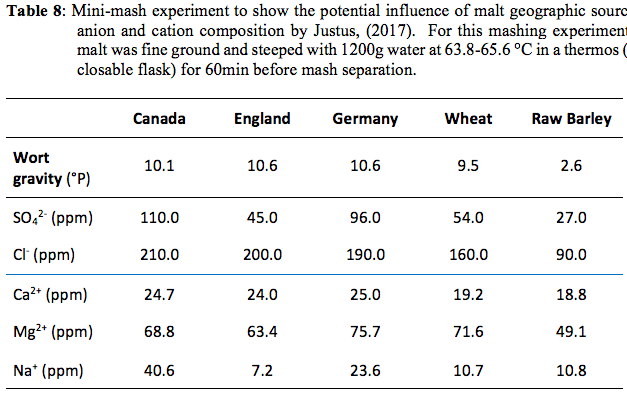
I concur with what both John Palmer and Daniel Carey have said. I would also underline what John pointed to with regards to the malt. Malt with its proteins and ions at a typical mash ratio of say 1 part malt grist to 3 parts brewing liquor has a substantial ability to buffer and contribute to the wort characteristics. To illustrate, this is a modest but very well targeted trial conducted by Aaron Justice (Brewmaster, Ballast Point Brewing). This and other observations concur that there is significant variability in cation/anion proportions in malts from different geographical sources (Terroir?). This understanding needs to be leavened by an excellent recent paper that considers the efficiency that those cations/anions are extracted into the wort and remain through kettle boiling, fermentation (Zn of course has its effect here - yeast nutrition) and finally the saleable beer.
See: Wietstock PC, Kunz T, Waterkamp H, Methner FJ. 2015. Uptake and release of Ca, Cu, Fe, Mg, and Zn during beer production. J Am Soc Brew Chem 73:179-184. https://doi.org/10.1094/ASBCJ-2015-0402-01<o:p></o:p> If you have further questions I can be contacted at tassiebeerdr@gmail.com.
------------------------------
D. Evan Evans
Dr
The Tassie Beer Dr
Lindisfarne TAS
61 362439556
------------------------------
Original Message:
Sent: 08-08-2023 12:49
From: John Palmer
Subject: HLT pH rise
Hi Tyrell,
The water pH generally doesn't matter.
The water pH generally doesn't matter for corrosion potential unless it's less than 5.
The water pH generally doesn't matter for determining mash pH.
The corrosion potential of the water generally depends on its ionic constituents (or lack thereof). You say that the source water is softened and the RO filtered and then you add some softened water back to get the TDS up, leaving 37 ppm Sodium (inconsequential). In other words, you are brewing with low mineral water – all mineral levels less than 50 ppm. This means that the malts in the mash will generally dominate the chemistry of the mash, and the mash pH will be about 5.8 (i.e., dominated by the base malt).
While I really would like to know the source water profile before softening, I would say that your pH rise is simply due to CO2 coming out of solution as the water temperature rises. Email me at john@howtobrew.com if you have any followup questions.
John
------------------------------
John Palmer
Owner
Palmer Brewing Solutions Inc
La Crescenta CA
------------------------------