Lots of great information in this thread already!
Full disclosure, we are an ALDC manufacturer, but I will only add data to add context and correct a couple things that have been brought up.
Directly relating to the original question, we adjusted our recommendations a few years back to also include an optional dry hopping addition. We've similarly recommended a secondary addition for fruited beers for the same reason.
Nick and Joel are correct that some ALDC on the market appears particularly sensitive to pH, and that the optimum is around 6.8. Mike's method of a smaller dose with each dry hop makes good sense given that the amount of precursors that arise from dry hopping is smaller than the amount that forms during normal fermentation, though for particularly large hop additions you may still with to split the dosing evenly between to account for the reduced activity at the lower pH, as Alex suggests.
However, data from our lab shows that at least our ALDC is not quite so precious as one might think (I don't have any data on other manufacturers products, so I can't make a broader claim). At a finished pH of 4.2, the relative activity is still around 60% of the optimum, meaning it will stay in the beer and be effective. The residual activity is even better (80%+) at pH of 4 or above (though that may not be as relevant - residual activity is when the pH drops to a given level, then returns to the optimum of 6.8).
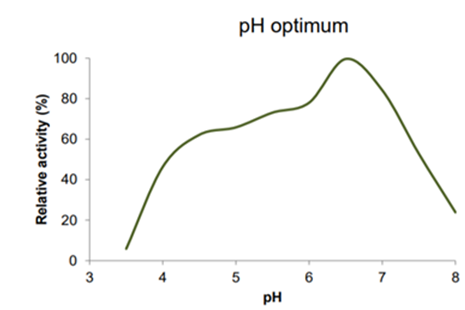
From this, most sour beers are not good candidates for dry hop dosing of ALDC.
Per Nick's experiment, we do recommend an addition both at knockout at dry hop for particularly challenging brews - Nick, correct me if I'm wrong, but it looks like the testing was either knockout or dry hop addition, but not both?
I ask because the knockout addition should have activity that the dry hopping addition would be supplementing - just as a slight correction to Joel's comment, below is our data for a generic dry hopped pale ale that had 3g/hl of ALDC added at knockout. This does show that the dose applied at knockout will still be somewhat effective, so long as the pH does not drop too far below 4.0 prior to that during fermentation:
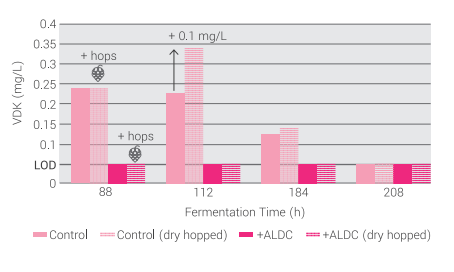
Also, as Mike noted, ALDC will only help with diacetyl, not alcohol production due to hop creep. All that said, Alex is 100% right that running a few trials to optimize the additions to your beers and process is the way to go!
------------------------------
Alan Windhausen
Technical Sales Manager
Murphy & Son Inc
Arvada CO
(720) 271-5541
------------------------------